- New

"Was that an earthquake? If you’ve ever asked that question — then this project is for you."
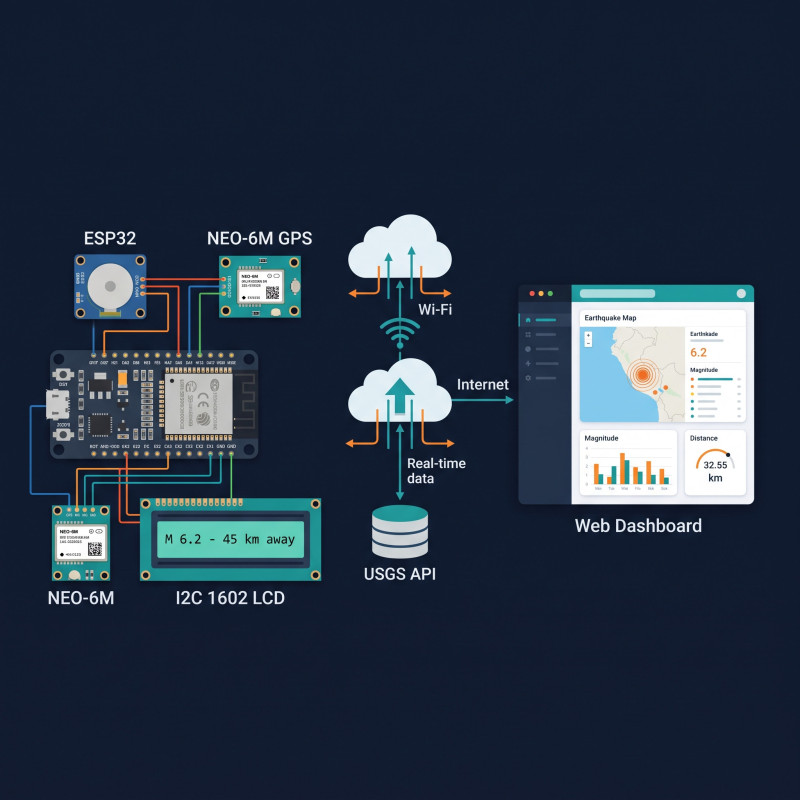
Stop doom-scrolling the news after every rumble. QuakeSense is a build-it-yourself ESP32 monitor that checks official USGS earthquake data for you, measures the exact distance from every quake to your home, and tells you in plain language whether you need to care — or can go back to sleep. Complete tested code, step-by-step PDF guides, and a preparedness checklist included.

Living near a fault line shouldn't mean living on edge.
Every time the ground shakes — or a friend texts "did you feel that?" — the same questions hit at once: Was that an earthquake? How big? Where was it? Is it close to me? Is something worse coming?
Most people answer those questions the stressful way: refreshing news sites and social media, reading conflicting numbers, and guessing.
QuakeSense gives you a calm, reliable answer in seconds — on a little device that sits on your shelf.
It is a complete DIY project built around an ESP32 board. It pulls earthquake reports straight from the USGS (U.S. Geological Survey), compares each epicenter with your location, and shows you exactly what matters:
A green light on your shelf, quietly saying "Nothing significant near you right now," is surprisingly powerful. And when something does happen, you get the facts instantly — not rumors.
What QuakeSense does
What you get (instant download)
📁 Complete Arduino firmware — clean, commented, ready to flash. Split into easy-to-read files so you can modify it.
📄 PDF 1 — Quick Start Guide — from unboxing to a working monitor, step by step.
📄 PDF 2 — Hardware & Wiring Guide — parts list, full pin table, wiring diagram, and build tips.
📄 PDF 3 — Code Walkthrough & Customization Guide — how every part works, and how to change radius, thresholds, region, alert behavior, and more.
📄 PDF 4 — Troubleshooting & FAQ — fixes for the problems people actually run into.
📄 PDF 5 — Earthquake Preparedness Checklist — a printable one-page family plan and emergency kit list, so your peace of mind rests on preparation, not just information.
🖼️ Gumroad-ready bonus: license file and a README to get going in minutes.
What you need
|
Part
|
Notes
|
|
ESP32 development board (e.g., ESP32 DevKit V1, 30-pin) |
The brain of the project |
|
16×2 LCD with I²C backpack |
Status display |
|
Active buzzer |
Audible alert |
|
RGB LED (common cathode) + 3 resistors |
Status light |
|
NEO-6M GPS module (optional) |
Auto-location; you can use fixed coordinates instead |
|
MicroSD card module (optional) |
Data logging |
|
Breadboard + jumper wires, USB cable |
Standard maker supplies |
Who is this for?
Skill level
Beginner-to-intermediate. If you've uploaded a sketch to an Arduino or ESP32 before, you can build this. No soldering is required (breadboard build), and the guides explain each step. Prefer to understand it deeply? The code walkthrough teaches the concepts as it goes.
Please read: what QuakeSense is — and isn't
We believe real peace of mind has to be honest, so here is the plain truth:
What it does do is replace anxious guessing with clear facts — and that, for a lot of people, is what turns fear into confidence.
Frequently asked questions
Do I need to know how to code? No. You flash the provided code and edit a few settings (Wi-Fi name, password, location). The guide walks you through each step.
Will it work where I live? Yes, anywhere in the world with internet access. USGS covers significant earthquakes globally.
Does it need GPS? No. GPS is optional; you can set fixed coordinates, which is usually all a home device needs.
Is there a monthly fee or account? No. The USGS feed is free, public, and needs no API key.
Can I change the alert distance and magnitude? Yes — all thresholds are simple settings, explained in the customization guide.
Can I modify and learn from the code? Absolutely. The license allows personal use and modification. (You may not resell or redistribute the files themselves.)
Refunds? Digital downloads can't be returned, but if something doesn't work, message me and I'll help you get it running.
Build it this weekend.
Grab your parts, download the package, and have a working QuakeSense by tonight — then let it keep an eye on things for you.
Get QuakeSense now.
Data source: USGS Earthquake Hazards Program (public domain data). QuakeWatch is an independent project and is not affiliated with or endorsed by the USGS.
"Was that an earthquake? If you’ve ever asked that question — then this project is for you."
Stop doom-scrolling the news after every rumble. QuakeSense is a build-it-yourself ESP32 monitor that checks official USGS earthquake data for you, measures the exact distance from every quake to your home, and tells you in plain language whether you need to care — or can go back to sleep. Complete tested code, step-by-step PDF guides, and a preparedness checklist included.