
Wire an ESP32 or Arduino to a Delta DVP PLC over RS-485, switch COM2 to Modbus RTU, and read or write D, M and Y...
Latest posts
-
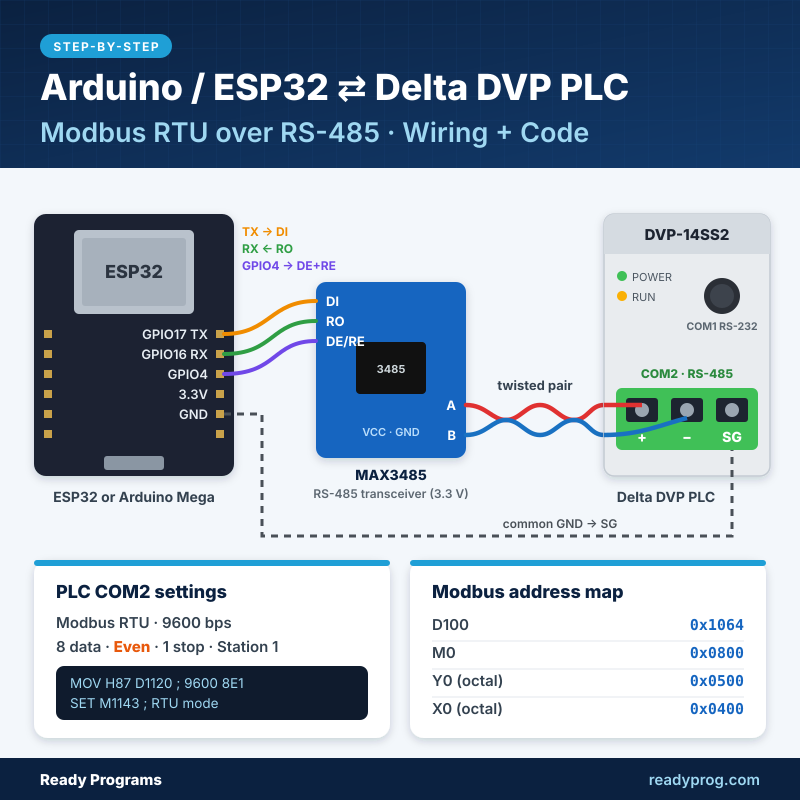 How to Connect an Arduino or ESP32 to a Delta DVP PLC with Modbus RTU (RS-485)Read more
-
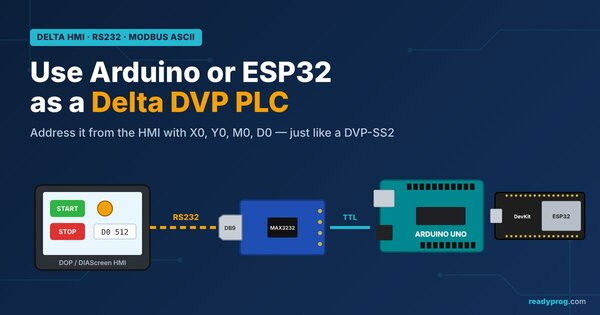 Use Arduino or ESP32 as a Delta DVP PLC: Control It from a Delta HMI via RS232Read more
Turn an Arduino or ESP32 into a Delta DVP-SS2 PLC that your Delta HMI talks to over RS232. Design screens with X0,...
-
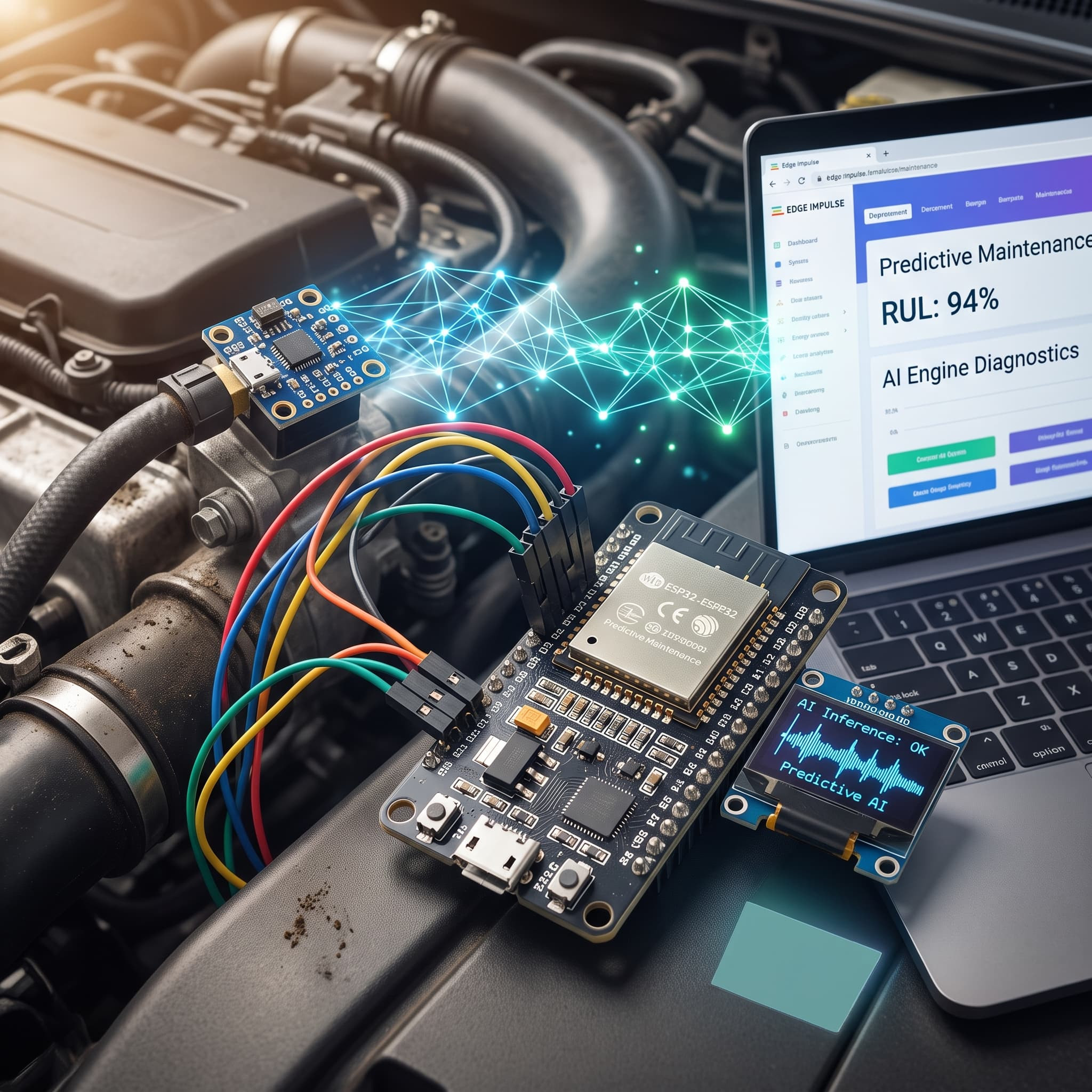 How AI Dictates When Mechanical Parts Must Be Replaced in Automotive and AerospaceRead more
Discover how Edge AI and microcontrollers like the ESP32 are revolutionizing vehicle and aerospace diagnostics. By...
-
 How to Choose a Graduation Project Idea in Computer Science & Software Engineering (2026 Guide)Read more
A practical, step-by-step guide to choosing a winning graduation project idea in computer science or software...
-
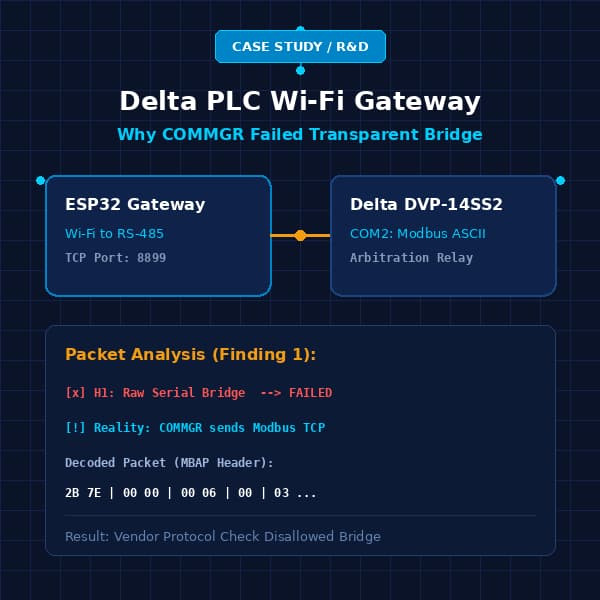 A Failed Wi-Fi Gateway for a Delta PLC: What a Packet Log Taught Me About Unverified AssumptionsRead more
I designed a sub-$7 wireless programming gateway for a Delta DVP-14SS2 PLC (ESP32, RS-485 transceiver, arbitration...
Blog categories
Search in blog
Archived posts
How to Choose a Graduation Project Idea in Computer Science & Software Engineering (2026 Guide)
A single decision at the start of your senior year can define your entire journey over the next eight months: What is your graduation project idea?
Many students spend weeks chasing an "astonishing" concept, only to realize midway through the semester that the scope exceeds their time, no one on the team understands the required tech stack, or the evaluation committee expected something entirely different. The outcome is often delays, stress, and a compromised deliverable that falls short of its potential.
In this guide, you will learn a systematic approach to selecting a graduation project idea and defining a clear project scope. This methodology will help you deliver a feasible project, defend it confidently in front of the committee, and build a standout asset for your post-graduate portfolio.
Why Choosing the Right Idea Matters More Than Writing Code
A graduation project is not evaluated solely by lines of code. Academic evaluation committees typically assess:
- Problem Clarity: How well-defined is the actual problem being solved?
- Design & Architecture Quality: Soundness of requirements analysis, system modeling (UML), and database schemas.
- Execution & Reliability: Does the system run smoothly and reliably during live demonstrations?
- Technical Articulation: Your ability to justify architectural decisions and handle defense questions confidently.
A practical idea backed by a well-defined scope helps you score highly across all these criteria. Conversely, an overly ambitious and vague project risks falling short—no matter how many thousands of lines of code you write.
Step 1: Assess Your Capabilities Before Searching the Web
Before browsing generic "Top Graduation Project Ideas" lists, take an objective inventory of your current standing:
What Skills Do You Truly Possess?
List the technologies you have actually built projects with (even small ones): programming languages, frameworks, databases, and UI/UX tools. Successful projects are typically built on 70% existing knowledge and 30% new learning, not the other way around.
Which Domain Interests You?
You will dedicate months to this work. If you enjoy game design, consider interactive or gamified educational software. If healthcare appeals to you, explore patient-monitoring solutions. If business systems interest you, look into inventory management or order processing. Genuine interest provides crucial momentum during demanding sprints.
How Much Time and Capacity Do You Actually Have?
Calculate the available weeks and the realistic weekly work hours you and your teammates can commit—subtracting exam periods and coursework. The available capacity is almost always smaller than initially estimated.
Step 2: Focus on a Real Problem, Not a Shiny Technology
A common misstep is starting with the tool: "I want to build an AI project" or "I want to build a Blockchain app." The better approach is to identify a concrete problem first, then choose the appropriate technology stack to solve it.
Where to Discover Practical Problems
- Campus Workflows: Course registration bottlenecks, facility scheduling, attendance tracking, library management, or student club coordination.
- Local Businesses & Organizations: Small clinics, pharmacies, repair shops, private schools, or real estate agencies that still rely on manual paperwork or disconnected spreadsheets.
- Personal Pain Points: Daily friction you face as an end user where you found yourself thinking, "Why isn't there a tool for this?"
- Existing Systems: Take an existing workflow and refine a specific dimension (performance bottlenecks, usability challenges, or missing integrations).
The "One-Sentence Pitch" Test
You should be able to state your project's premise in a single, coherent sentence:
"A [system type] that helps [target user group] solve [core problem] by [primary mechanism/method]."
Example: "A web application that helps small dental clinics automate appointment scheduling and reduce no-shows through automated reminders and an intuitive physician dashboard."
If you cannot summarize your concept into this structure, the idea is not yet clearly focused.
Step 3: Evaluate Your Ideas Against Objective Criteria
Avoid relying on gut feeling alone. Score each shortlisted idea on a scale of 1 to 5 across the following benchmarks:
Idea Evaluation Matrix
- Feasibility: Can it be completed within the semester using your current skills?
- Problem Validation: Does it address a real pain point for actual users?
- Technical Depth: Does it contain sufficient architectural, data modeling, and programming rigor to qualify as a capstone project (rather than just simple CRUD pages)?
- Academic Alignment: Does it satisfy your department's grading rubrics and your advisor's domain focus?
- Resource Availability: Are required datasets, public APIs, libraries, and hardware readily available and accessible?
- Career Value: Will this serve as a compelling showcase piece on your GitHub profile and resume?
Total the scores across 3 to 5 candidate concepts; the most viable option will usually emerge clearly.
Step 4: Project Concepts by Domain (For Inspiration)
Use these overarching tracks as inspiration to refine and tailor to your specific context:
Web Application Projects
- Operational management platform for specialized clinics, pharmacies, or training centers.
- Booking and resource-scheduling system with automated alerts and reporting modules.
- Order-fulfillment and inventory tracking portal for small retail businesses.
Mobile Application Projects
- Academic task manager for university students featuring automated deadline notifications.
- Incident reporting and municipal maintenance tracker for campuses or residential complexes.
- Gamified micro-learning mobile app designed for specific skill acquisition.
AI & Machine Learning Projects
- Personalized recommendation engine for educational content or e-commerce products.
- Domain-specific text classifier (for sentiment, customer support, or news feeds) with a functional UI.
- Predictive analytics dashboard using verified open datasets paired with clear business insights.
IoT & Embedded Systems
- Environmental telemetry platform (temperature, air quality, anomaly alerts) connected to a web interface.
- Access-control or attendance management system utilizing smart sensors and real-time logging.
Cybersecurity & Data Analytics
- Vulnerability assessment dashboard designed for testing sandbox applications in authorized environments.
- Interactive data visualization suite translating open-source intelligence into actionable visual insights.
Note: Having a similar idea already exist on the web is not a disqualifier. What matters is your distinct perspective—tailoring it to a specific user demographic, adding a unique capability, improving user flow—and thoroughly understanding every line of your implementation.
Step 5: Define the Project Scope with Precision
Selecting the idea is only the first half of the battle. The second half is scope definition: identifying exactly what your project will—and will not—do.
What Is Project Scope?
Project scope is the documented boundary of your project work: included features, supported user roles, target platforms, system constraints, and explicitly excluded features. The lack of documented boundaries is the root cause of scope creep, where incremental feature additions accumulate until completing the project becomes impossible.
Step-by-Step Scope Definition
1. Define 3 to 5 Core Objectives: Keep them measurable and concise (e.g., "Allow patients to book an appointment in under 60 seconds.").
2. Categorize Features Using the MoSCoW Method:
- Must-have: Essential functionalities without which the system cannot function.
- Should-have: High-value additions to implement once critical paths are complete.
- Could-have: Nice-to-have enhancements if surplus time permits.
- Won't-have (Out of Scope): Explicitly documented features that will not be built during this development cycle.
3. Keep User Roles Lean: Each added role (Admin, Manager, Customer, Auditor) multiplies business logic and permission handling. Start with two or three foundational roles.
4. Fix Your Platform Early: Decide whether it is Web-only or Web + Mobile. Supporting multiple platforms significantly increases design, integration, and QA overhead.
5. Outline Constraints and Assumptions: For instance, "Supports modern desktop browsers only" or "Assumes a continuous internet connection."
6. Build a Realistic Timeline: Divide your milestone calendar into analysis, architecture, coding, testing, documentation, and mock defenses. Reserve a 15% to 20% time buffer for unforeseen roadblocks.
The Golden Rule: Deliver a Solid MVP First
Ask yourself: "What is the leanest functional version (Minimum Viable Product) that demonstrates technical competence to the evaluation committee?" Build and validate this version first before expanding. A focused, fully functional system will consistently outperform an expansive system that crashes during live presentation.
Common Pitfalls to Avoid
- Overscoping Beyond Team Capacity: Attempting to build an end-to-end social network or an enterprise-grade ERP system in a single semester.
- Adopting Tech Stacks You Don't Understand: You will be questioned closely on your choices during your defense; ungrounded buzzwords create immediate vulnerabilities.
- Siloing Away from Your Advisor: Your academic advisor knows departmental expectations. Present your ideas and updates early and often.
- Neglecting Scope Documentation: Working without written boundaries leads to frequent mid-semester pivots and burnout.
- Postponing Documentation: System documentation carries significant weight in grading; it is not a chore to leave for the final 48 hours.
- Relying on Unverified External APIs or Data: Confirm the availability, licensing, and access limits of third-party APIs and datasets before building your core architecture around them.
- Forgetting the Final Demo Constraints: Plan ahead: How will we showcase this system in a 15-minute presentation? Which key workflow best demonstrates its value?
Pre-Submission Validation Checklist
Before submitting your final project proposal, ensure you can answer "Yes" to every item:
- Can I articulate the problem and its solution in a single sentence?
- Do I have a well-defined picture of the system's primary user persona?
- Have I drafted a clear list of Must-Have features alongside explicit Out-of-Scope exclusions?
- Does our timeline realistically accommodate testing, bug fixing, and documentation?
- Does the team already possess—or have a concrete plan to learn—the required tech stack?
- Has our academic supervisor reviewed and endorsed the proposed scope?
- Can I confidently explain and defend every design and architectural decision?
Leveraging Pre-Built Solutions and Starter Kits Strategically
In industry practice, software engineers rarely build standard infrastructure from scratch. Professional developers leverage battle-tested open-source libraries, UI kits, and solid foundational templates every day. The key distinction lies in mastery and understanding:
- Use reliable boilerplates to handle boilerplate components (authentication scaffolding, admin dashboard shells, standard CRUD routines) so your team can focus on unique business logic.
- Review, comprehend, and customize every integrated component to ensure it aligns precisely with your project scope.
- Prepare to explain the architectural structure and implementation details clearly in your own words.
- Ensure full compliance with your academic department’s code-reuse policies, properly citing reference libraries and third-party frameworks.
Specialized developer resource platforms help eliminate weeks of repetitive setup, allowing you to focus on tailoring features, polishing user experience, and walking into your project defense with confidence.
Summary
Choosing a graduation project is not about picking the most convoluted idea—it is about disciplined execution:
- Audit your core competencies, genuine interests, and available hours.
- Identify a verified problem and frame it in one clear sentence.
- Evaluate alternatives systematically using weighted criteria.
- Define project boundaries using the MoSCoW scoping framework.
- Deliver a robust MVP before building auxiliary features.
- Document incrementally and maintain continuous alignment with your supervisor.
Kickstart Your Graduation Project on Solid Ground with ReadyProg
Have a clear direction but need a stable foundation to accelerate your development? Or are you evaluating several ideas and looking for reference implementations to determine practical feasibility?
Explore the pre-built code solutions and modular software frameworks available on readyprog.com. Find the starting architecture that aligns with your domain, customize it to your academic specifications, and gain deep mastery over the codebase so you can defend your work with confidence. Reach out if you need guidance matching technical templates to your project scope.
Start smart today, and turn your graduation project into the launching pad for your software engineering career.
Frequently Asked Questions (FAQ)
What is the ideal project size for a Computer Science capstone?
There is no rigid line-count requirement; depth depends on your team size, timeframe, and department regulations. As a general rule: a focused, well-documented, and thoroughly tested project completed within schedule will always grade higher than an unfinished mega-project.
Is it acceptable to pick a project idea that already exists?
Yes, provided you introduce clear differentiation (a distinct audience segment, refined workflow, improved performance, or unique features), adhere to your department’s guidelines, and possess an end-to-end understanding of your codebase.
When should our team formalize the project scope?
Immediately after confirming the core concept and before writing project code. A written scope protects your team against feature creep and keeps advisor feedback focused on concrete objectives.
Is it better to build a Web, Mobile, or AI project?
The right choice depends on your team’s existing skills, project duration, and academic guidelines. A polished, reliable full-stack web application is significantly better than an unstable AI project whose underlying math and models the team cannot defend.
How should we prepare for the defense committee's questions?
Make sure every team member can articulate why specific architectural choices, database structures, and libraries were selected. Rehearse an end-to-end demo script, and be prepared to walk through your code's most complex logic on demand.
```
Posted in:
Graduation Projects
Leave a comment